
By Havlyn Gill. Updated 3:25 p.m., Thursday, October 12th, 2023, Atlantic Standard Time (GMT-4).
What is climate change?
Climate change (CC) is a global crisis that has far-reaching consequences for our planet, affecting ecosystems, weather patterns, sea levels, and economies. Gone are the days when CC was or should be considered a solely scientific or environmental problem. It is a multisectoral issue requiring multiscale and multilevel dynamic solutions. At its core, CCrefers to the long-term alteration of Earth’s climate, which can manifest in various ways, including rising global temperatures, extreme weather events, and shifts in precipitation patterns. One of the key benchmarks in addressing CC is limiting global warming to 1.5 degrees Celsius above pre-industrial levels, rather than allowing it to reach 2 degrees Celsius. This seemingly small temperature difference can have profound impacts, particularly for Small Island Developing States (SIDS) in the Caribbean as is evident in St Vincent and the Grenadines (SVG).Unfortunately, though we are negligible emitters, we are the major burden bearers.
Understanding Climate Change
CC is primarily driven by human activities (anthropogenic causes), including the burning of fossil fuels, deforestation, and industrial processes. As such, United Nations Framework Convention on Climate Change, Article 1 defines CC as ‘a change of climate which is attributed directly or indirectly to human activity that alters the composition of the global atmosphere and which is in addition to natural climate variability observed over comparable time periods.’ Notably, there are natural processes that contributes to CC such as volcanic activities, plate tectonics and Earth’s orbiting around the sun. These activities release greenhouse gases (GHGs), such as carbon dioxide (CO2) and methane (CH4), into the atmosphere. These gases trap heat from the sun and lead to a gradual increase in global temperatures, a phenomenon known as the greenhouse effect.
The Consequences of 1.5°C vs. 2°C Warming
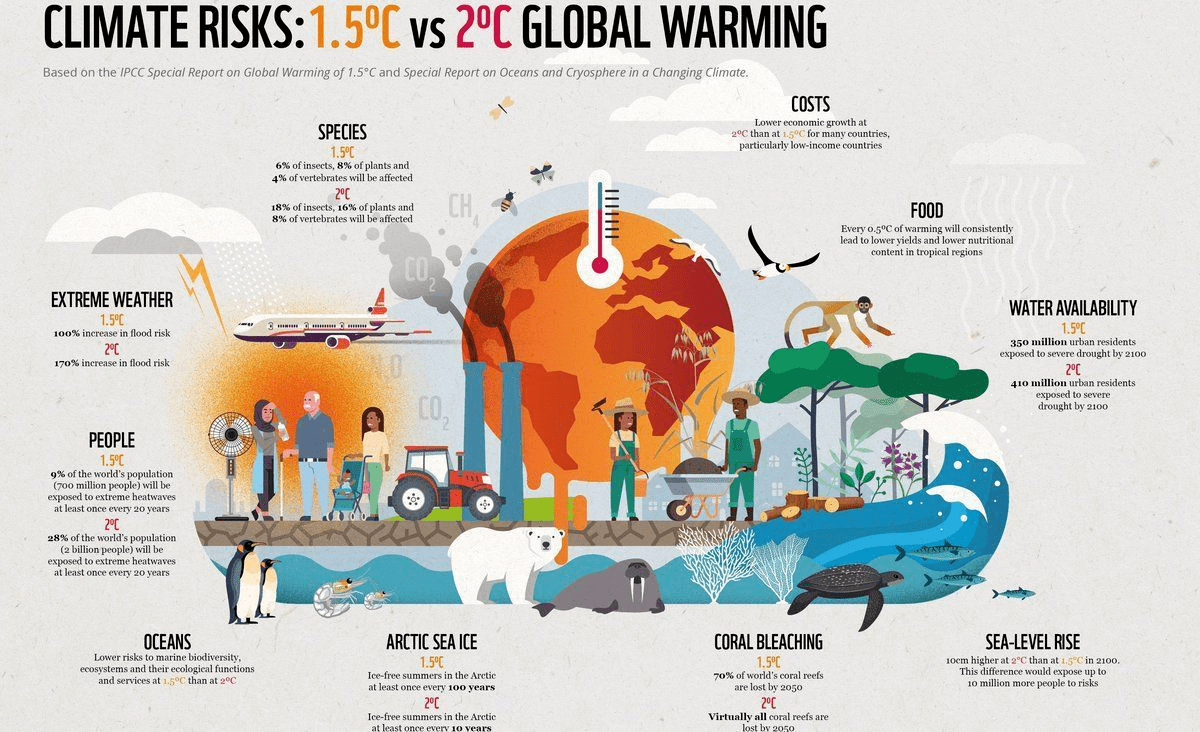
The Paris Agreement, adopted in 2015, set the goal of limiting global warming to well below 2 degrees Celsius above pre-industrial levels while striving to limit it to 1.5 degrees Celsius. The difference between these two targets is crucial, as it has a significant impact on the severity of climate-related impacts.
1. Sea-Level Rise: Even a half-degree increase in global temperature can result in higher sea levels, which disproportionately affect low-lying coastal areas which is the topography of most Caribbean islands. At 2 degrees Celsius of warming, sea levels are projected to rise more rapidly, inundating critical infrastructure and displacing communities in SIDS. Evidence of this occurrence is the eroding coastlines of Sandy Bay and Shipping Bay.
2. Extreme Weather Events: A 2-degree warming scenario increases the likelihood of extreme weather events, including hurricanes (Hurricane Elsa/Maria/Tomas/Ivan) and heatwaves. These events can devastate the fragile economies and ecosystems of SIDS.
3. Coral Reefs: Coral reefs, crucial for marine biodiversity and coastal protection, are highly sensitive to temperature increases. Limiting warming to 1.5 degrees Celsius offers a better chance for the survival of these ecosystems, which are vital to the livelihoods of island communities.

SVG, like many other SIDS in the Caribbean, is already feeling the adverse impacts of climate change. This ongoing heatwave is exacerbating these challenges. High temperatures lead to heat stress, adverse public health, crop failures, and water shortages thus threatening food security. According to the Meteorological Services SVG, on October 4, 2023, 33.9 degrees Celsius temperature was recorded as the highest temperature since July 1979 where it was 35.6 degrees Celsius. In the Caribbean, heatwaves can also intensify the frequency and severity of hurricanes, compounding the risk of damage to infrastructure and human lives.
The Importance of Urgent Action
The urgency of limiting global warming to 1.5 degrees Celsius cannot be overstated. Here are some key steps that need to be taken to address this pressing issue:
1. Rapid Transition to Renewable Energy: Reducing GHG emissions by transitioning to clean, renewable energy sources is essential. SIDS can benefit from solar, wind, and geothermal energy to reduce their reliance on fossil fuels.
2. Coastal Protection: Investing in coastal protection measuresboth hard and soft engineering to complement each other, such as mangrove restoration, beach nourishment (soft measures, promotes coastline restoration, long-term sustainability), groynes and gabion baskets (hard measures, immediate short-term solution) can help mitigate the impact of rising sea levels and storm surges.
3. Climate Adaptation: Developing and implementing climate adaptation strategies is crucial for SIDS to build resilience against climate impacts. These strategies should include improved infrastructure, and enforced building codes disaster preparedness, and sustainable land use planning.
4. Global Solidarity: The international community ought to provide financial and technical support to SIDS to help them cope with the impacts of climate change that is mainly attributable to their actions and transition to a more sustainable future. Although, this has been more a moot point of political discussion over a decade rather than action.
CC poses an existential threat to the world, with SIDS being particularly vulnerable. Limiting global warming to 1.5 degrees Celsius rather than 2 degrees Celsius is not just an ambitious goal; it is a lifeline for these nations. Urgent action is required to reduce greenhouse gas emissions, protect coastal areas, and build resilience in the face of ongoing climate challenges. It is a collective (public and private stakeholders) responsibility to ensure that SIDS can continue to thrive in the face of this global crisis.
Shernell S.S. Hadaway
MSc Climate Change and Environmental Policy
Student, University of Leeds
SusLiving Consultancy
 One News SVG