
By Admin. Updated 5:55 a.m., Wednesday, January 10, 2024, Atlantic Standard Time (GMT-4).
The government will, this year, implement a closed season and an open season for harvesting conch.
Minister of Agriculture, Forestry, Fisheries, Rural Transformation, Industry, and Labour – Saboto Caesar made the announcement on Tuesday (January 9) during his contribution to the debate on the 2024 Appropriations Bill (the budget).
“All citizens are very concerned about the conch,” Mr. Ceasar said.
“In 2024, there will be an announced closed season and an open season for conch,” he said, adding that, “we must protect our resources while we harvest them in a sustainable way”.
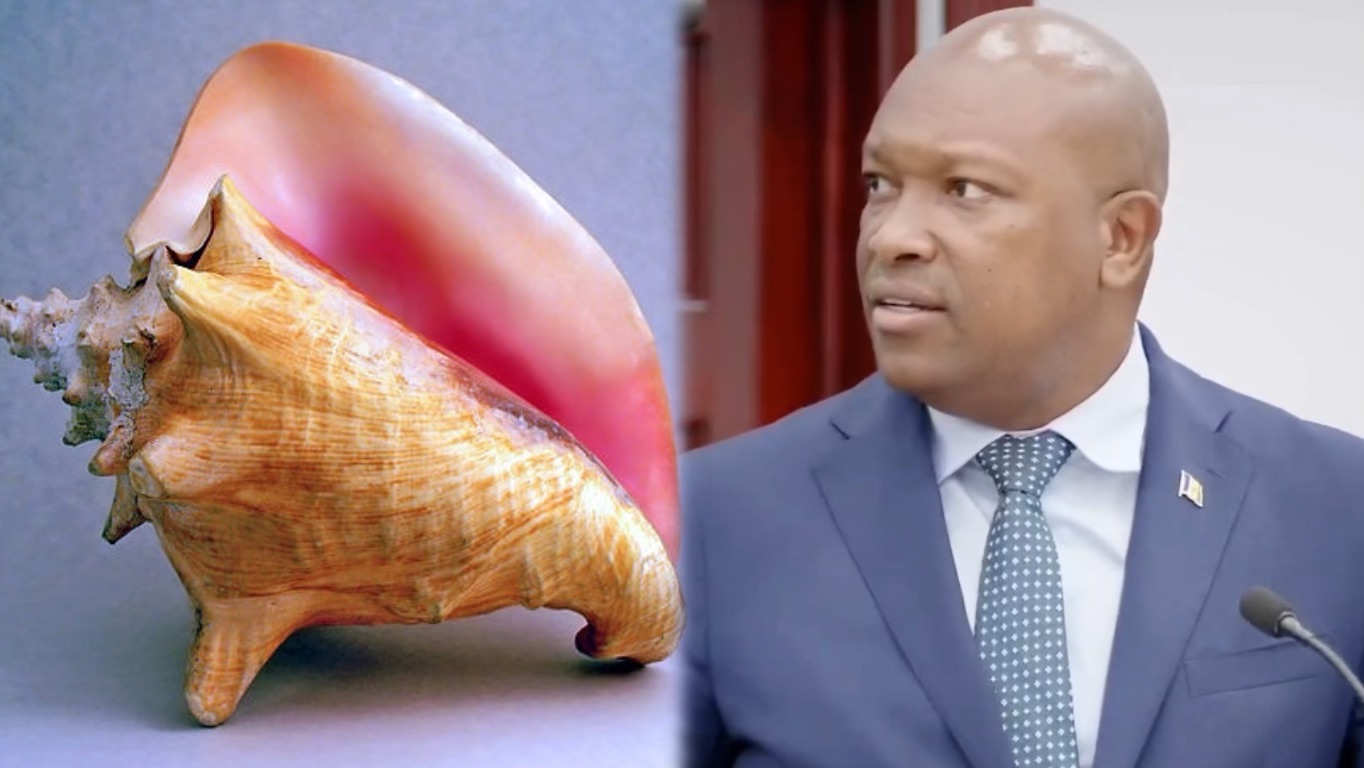
Conch is an edible sea Mollusk used by many as a delicacy.

In addition to being a consumable food item, conch may contain valuable pearls, and the conch shells can also be sold.
The main conch variety found in St. Vincent and the Grenadines (SVG) is the Queen Conch, and the conch is mainly harvested in the Grenadines.
The conch has been under threat in St. Vincent and the Grenadines for many years, but more so in recent times due to its high export value.
A 2021 report by the Caribbean Natural Resources Institute – CANARI presented four threats to conch in St. Vincent and the Grenadines.
The threats included current or threatened habitat destruction or modification or curtailment of habitat or range; overutilisation for commercial purposes; inadequacy of existing regulatory mechanisms; and other natural or man-made factors affecting the species’ continued existence, according to a NOAA 2014 study.
In that same CANARI report, it was presented that in 2002, the United Nations Food and Agriculture Organisation – FAO listed the Conch fishery in SVG as overexploited, with a minimum size restriction of 7 inches.

Some of the other living creatures whose harvesting has been subjected to open and closed seasons are iguanas, lobsters, manicous, agoutis, armadillos, and certain pigeons.
Livelihoods and be affected if too much of our wildlife and marine life are harvested in an unsustainable way
People can harvest, and in some cases hunt, for the protected animals to help meet protein and cuisine needs during the open season, but hunting or harvesting them during the closed season is illegal and subject to fines and jail time.
 One News SVG