


By Demion McTair. Updated 4:02 p.m., Friday, February 23, 2024, Atlantic Standard Time (GMT-4).
What if there were to be an amendment to the Building Codes and Guidelines of St. Vincent and the Grenadines (SVG) to stipulate that all buildings and new developments of a certain size should have renewable energy systems in place to reduce dependence on fossils?
St. Vincent and the Grenadines (SVG) is undertaking large-scale infrastructural development. Since buildings are considerable consumers of electricity, more buildings such as large hotels, the Kingstown Port Modernisation Project Administrative Building, schools, new healthcare facilities, and the like, would mean the country is poised to markedly increase its energy consumption from buildings.
Since the majority of energy generation comes from the burning of fossil fuels, there is no doubt that the country’s carbon emissions will increase markedly in the coming years.
With this expansion in energy use, St. Vincent and the Grenadines must try to live up to its commitment to achieving United Nations Sustainable Development Goal No. 7 “which is about ensuring access to clean and affordable energy, which is key to the development of agriculture, business, communications, education, healthcare, and transportation,” according to the UN’s website.
SVG’s inevitable increase in energy use can be constrained, however, and the answer to how that could be done could be found in India.

India’s government, under the Energy Conservation Building Code of 2017 made a bold move to ensure its commercial buildings are energy efficient.
Currently, buildings account for over 40 percent of India’s energy consumption, according to India’s The Energy and Resources Institute – TERI.
Among other things, India’s Energy Conservation Building Code of 2017 stipulates that buildings or building complexes that have a connected load of 100 kW or a contract demand of 120 kVA or greater and are intended to be used for commercial purposes, must generate a percentage of their energy on-site from renewable sources such as solar.
Such buildings include schools, hospitals, supermarkets, shopping complexes, and hotels.

While some states in India are still implementing the measures, the overall impact in the coming years is expected to be felt largely bringing cost savings and occupational benefits. According to India’s Ministry of Power, the 2017 code implementation is estimated to achieve a 50% reduction in energy use by 2030.
“With the adoption of ECBC 2017 for new commercial building construction throughout the country, it is estimated to achieve a 50% reduction in energy use by 2030. This will translate to energy savings of about 300 Billion Units by 2030 and peak demand reduction of over 15 GW in a year,” the ministry said.

Is such a requirement needed in SVG?
St. Vincent and the Grenadines and India have their own unique challenges and opportunities when it comes to energy production, energy use, and climate compliance.
On the one hand, St. Vincent and the Grenadines (SVG), a 150-square-mile country, cannot nearly contribute to global carbon emissions in the way that India at 1,269,219 sq miles can and does. India is 8,461.46 times larger than SVG in land space and has a population that’s nearly 13,000 times that of SVG.
St. Vincent and the Grenadines has, however, been making some important strides in the area of renewable energy production.

According to information received from the government’s Energy Unit, within the Ministry of Urban Development, Energy, Seaports, Grenadine Affairs and Local Government, as of July 2023, the total installed capacity of solar pv systems throughout St. Vincent and the Grenadines was 5190 kW (5.19 MW).
“Data obtained from VINLEC suggests that VINLEC and the Government of St. Vincent and the Grenadines have a combined total installed capacity of 3137 kW (3.137 MW) of solar PV. VINLEC advised that as of July 2023, there were 367 grid-connected solar pv systems installed nationwide with 339 installations done by private (both residential and commercial) consumers –yielding a total installed capacity of 2052 kW (2.052 MW),” the Energy Unit told One News SVG on February 14, 2024.
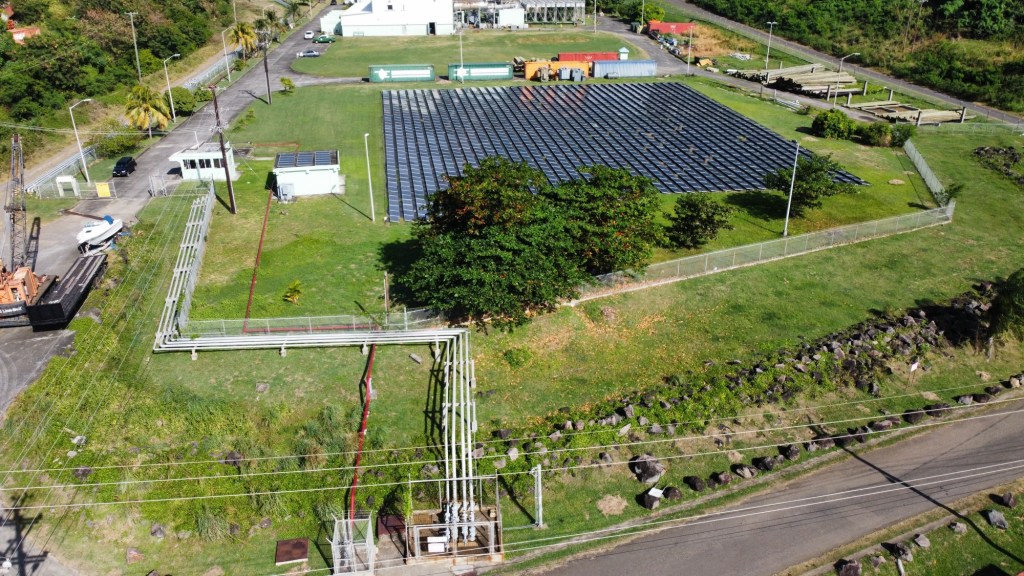
The country has also installed solar farms to enhance energy production.
The Energy Unit said the largest solar projects it has spearheaded:
1. Argyle International Airport Solar Farm– At present, 1.1 Megawatt (MW) of solar pv have been installed at the AIA Solar Farm, with the primary objective of reducing the operating expenses at the Argyle International Airport. The Solar Farm was constructed in 2018 with 522 kW installed through a collaborative effort between the Energy Unit (through the UNDP GEF funded Promoting Access to Clean Energy ‘PACES’ Project) and VINLEC. In 2019, the Energy Unit added a further 75 kW through a grant obtained from the UNEP GEF funded Energy for Sustainable Development ‘ESD’ Project. Through the more recent Sustainable Energy for the Eastern Caribbean (SEEC): Energy Efficiency and Solar Photovoltaic Plant Project, a further 500 kW was added to the existing solar farm in September 2023.
2. SVG Community College: Division of Technical and Vocational Education– a 200 kWsystem was installed through a World Bank funded project to strengthen the Technical and Vocational Education and Training (TVET) and the Electrical Engineering Associates programmes at the SVGCC DTVE- as well as to reduce the cost of electricity due to the higher electricity demand associated with the use of TVET equipment and associated programmes.
3. The Grenadines Transition Project: This consists of two solar farms with battery storage located on the islands of Union Island and Mayreau. Upon commissioning, these plants were officially handed over and are currently being managed by VINLEC:
(3a) Union Island Microgrid – This system consists of a 600 kW solar PV plant with 600 kWh lithium-ion battery storage integrated with the existing diesel power plant – capable of supplying 100% of Union Island’s daytime power needs. This is estimated to displace 320,000 litres of diesel and 825 tonnes of Carbon Dioxide annually. This has resulted in a cost savings of an estimated $870,000 (XCD) to the Government and people of St. Vincent in the Grenadines.
(3b) Mayreau Microgrid – This system consists of a 100 kW hybrid solar PV plant with 200 kWh lithium-ion battery storage integrated with the existing diesel power plant. Though initially met with challenges as it pertains to the increase in electricity demand and other technical issues, VINLEC has advised that this plant is now producing electricity for the residents of Mayreau.
Still, many new buildings are being constructed and a requirement to safely generate solar with the highest quality standards could help the country meet its annual energy quota.
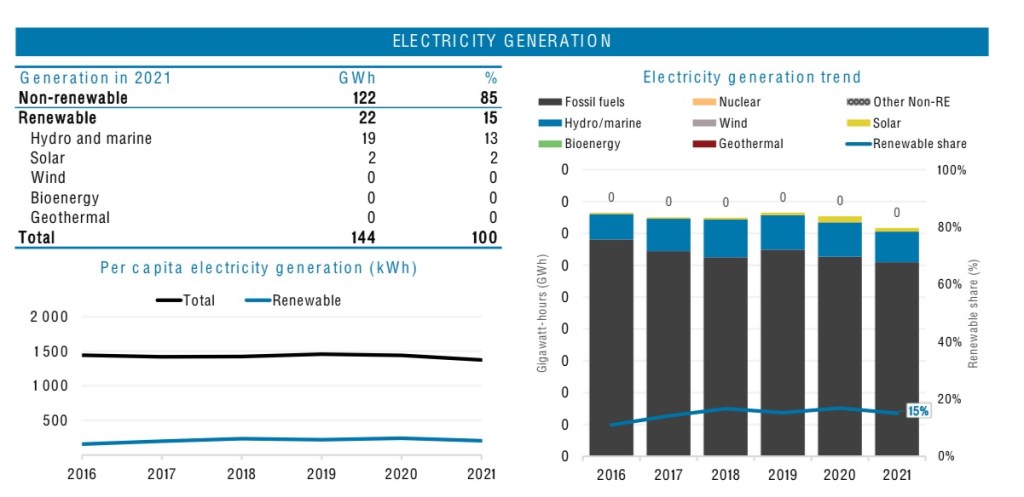
According to data published by International Renewable Energy Agency – IRENA, 85 percent of St. Vincent and the Grenadines’ energy production in 2021 came from oil, a total of 122 GWh. Renewables only accounted for 15 percent or 22 GWh.
The main renewables are hydro and solar with hydroelectricity production at 13 percent or 19 GWh and solar at 2 percent or 2 GWh.
There was no recorded production from wind or geothermal energy.
Hydro energy production is largely contingent upon levels of rainfall, among other factors.
On the other hand – India
India’s energy and climate situations are complex.
With 1.4 billion people, a size of 1,269,219 sq miles, an air quality problem in some states due to the burning of coal, emissions from the transportation system, agricultural and industrial pollution, and other factors, India has been working hard to reduce reliance on coal and natural gas.
It has been trying to make its transportation system more energy-efficient and climate-compliant, and it has been promoting the use of clean coal while emphasizing renewable energy production, among other measures.
In other words, increasing the production and use of clean energy is an imperative in India due to the environmental fallout the country has faced due to high reliance on fossil fuels.

Verdict
While St. Vincent and the Grenadines might not have the land space for grand solar farms, and while battery storage technology in the world is still developing, SVG can focus its solar energy thrust on ensuring its large buildings and building complexes are outfitted with solar energy to promote more energy-efficient buildings.
Changing the building codes to facilitate this is not a bad idea, but such actions must be guided by stakeholders in energy, engineering, health and safety, customs and excise, and academia.
While solar will never be SVG’s energy savior, its wide and safe use can help buildings to be more energy-efficient. Once the energy use in large buildings can be reduced, it will be to the overall benefit of everyone.
 One News SVG
2 comments