
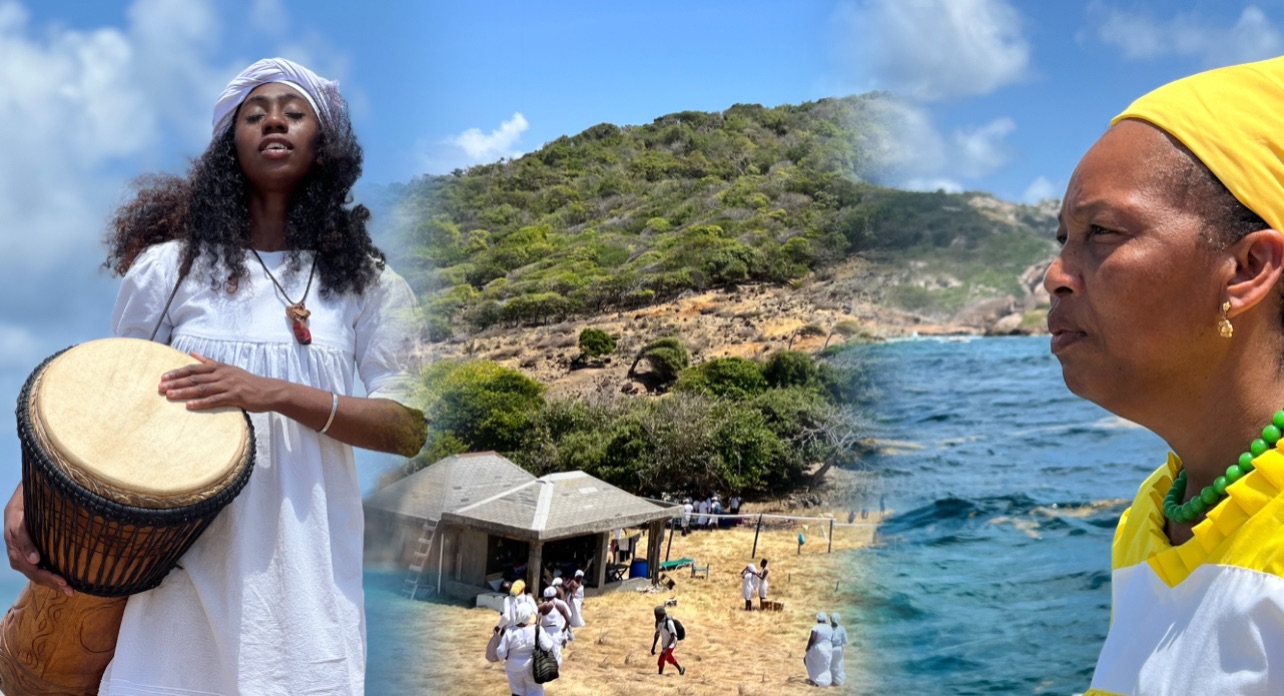


By Admin. Updated 2:50 p.m., Thursday, March 6, 2025, Atlantic Standard Time (GMT-4).
The government of St. Vincent and the Grenadines has fulfilled its promise to acquire the Northern Grenadines island of Baliceaux, where indigenous people were exiled in the 1700s.
In a ministerial statement delivered in Parliament today (March 6), Prime Minister Dr. Ralph Gonsalves announced the acquisition.
He noted that the acquisition was published in the official Gazette of the Government on March 4.
One News SVG obtained a copy of the Gazette and confirmed the acquisition; however, no price for the land was listed. Several websites over the years have advertised the island for sale at USD 30 million, but the state has never announced a willingness to grant any development licenses due to the historical significance of the land and its surrounding waters for bird and fish populations.
In its Second Publication, the Gazette states, quoting Section 3 of Chapter 322 of the Land Acquisition Act, that all 323 acres have now been vested absolutely in crown.
The Gazette states:
“WHEREAS it is enacted by Section 3 of the Land Acquisition Act Chapter 322 that if the Governor General considers that any land should be acquired for a public purpose, he may cause a declaration to that effect to be made: AND WHEREAS it is considered by the Governor General, that the under mentioned parcel of land should be acquired for a public purpose, to wit, for the purpose of a cultural/historic/memorial site and to keep as part of our national patrimony.”
The official document further states, “NOW IT IS HEREBY DECLARED by her Excellency, the Governor General, acting in accordance with the advice of the Cabinet of Saint Vincent and the Grenadines, that upon the Second Publication of this Acquisition in the Gazette, the lands shall vest absolutely in the Crown, all that portion of lands situated at Baliceaux, in the Parish of the Grenadines in the State of State of St. Vincent and the Grenadines, belonging to whom it may concern, and measuring approximately three hundred and twenty-three (323) acres, together with all ways water and watercourses rights, lights, liberties, privileges, paths, easements and all appurtenances thereon shall vest absolutely in crown.”
During his address on National Heroes Day in 2024, Prime Minister Dr. Ralph Gonsalves reiterated his government’s intention to acquire the island, owned by the Lindley family, which they bought in the 1800s, long after the British exile events.

The island holds significant historical value to the descendants of Garifuna who survived the native genodice and exile and see the land as sacred ground.
Hundreds of Garifuna, a hybrid race created when Africans and Kalinagos (yellow Caribs) inter-bred in St. Vincent. Over several centuries, they led the strongest residents against British colonisation, ultimately resulting in St. Vincent having the shortest period of slavery in the Caribbean.
The last mounting of resistance was made by Paramount Chief Joseph Chatoyer who was killed in March 1795. After his death, about 5,000 of the Garifuna were rounded up by the British and exiled to Baliceaux, a barren land where more than 2,000 of them died.
Those who survived the exile to Baliceaux were shipped to Rotaan in Central America, from which they settled in British Honduras (Belize), Nicaragua, Guatemala, and other Central American territories. Many of them managed to preserve their culture and are now helping the decedents of the Indigenous community in St. Vincent to regain the Garifuna language and aspects of their culture.
For many of the Garifuna overseas, the acquisition of Baliceaux has been a missing piece of the puzzle to reconnect them to their ancestral roots and to give proper burials to their ancestors who were left to die on the island. Many in Central America and the USA have called for the island to be a shrine.


 One News SVG