



The views expressed herein are solely those of the writer.
“Principles only mean something when it is inconvenient to stand by it.”: US Expanded Visa Restrictions on Cuba’s medical-assistance programme
On February 25, 2025, US Secretary of State, Marco Rubio put out a statement on the US Department of State webpage titled, “Expansion of Visa Restrictions Policy for Individuals Exploiting Cuban Labor”. This policy is not* entirely novel, as it is an expansion of an existing Cuba-related visa restriction. I believe Mr Rubio was referring to the Biden administration policy in which Biden signed a spending bill – following the administration’s formal accusation of Cuba profiting from forced labour – requiring the State Department to impose sanctions on third-country officials who hired work brigades from Cuba. Similarly, the statement put out the current Secretary of State reads:
“Today, we announce the expansion of an existing Cuba-related visa restriction policy that targets forced labor linked to the Cuban labor export program. This expanded policy applies to current or former Cuban government officials, and other individuals, including foreign government officials, who are believed to be responsible for, or involved in, the Cuban labor export program, particularly Cuba’s overseas medical missions. . . Cuba continues to profit from the forced labor of its workers and the regime’s abusive and coercive laborpractices are well documented. Cuba’s labor export programs, which include the medical missions, enrich the Cuban regime, and in the case of Cuba’s overseas medical missions, deprive ordinary Cubans of the medical care they desperately need in their home country.”
In Diana Tussie and Pia Riggirozzi journal article, A global conversation: rethinking IPE in post-hegemonic scenariosspoke about the notion of followership that adds a relational dimension to the discussion regarding regional powers; besides hegemonic politics, region can be constructed on the basis of consensual views and interests that, although advanced and guaranteed by the leader, reflect the position of the followers. We’re witnessing regional leaders taking a stance on positions on matters of political economy that reflects the views and interests of most, if not all, CARICOM heads.
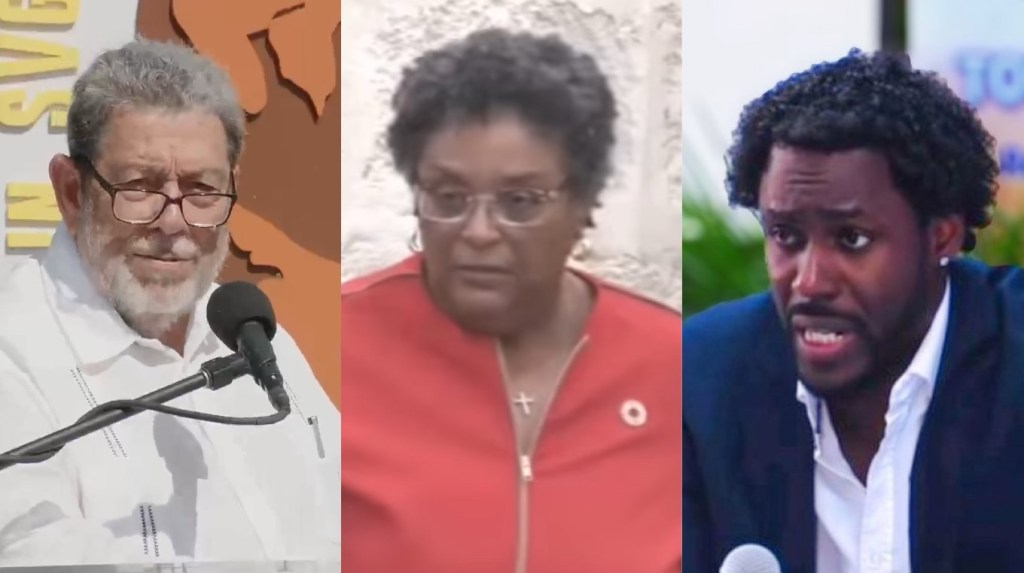
Following the announcement of US’s expanded policy targeting Cuban labour, for instance, several Caribbean leaders have since came out in solidarity with Cuba in a bold and defiant stance against the Trump’s administration’s policy. For example, Prime Minister of St Vincent and the Grenadines, the Most Honourable Dr Ralph E. Gonsalves in addressing the matter, stated in a fiery speech on March 9, 2025: “I was born a rebel. I was born with a rebel seed. I was a young rebel. I am today, an old rebel. . . I know we are not involved in any exploitation of any Cuban medical workers. And I know that the Cuban government is not involved either.. . And I believe that the Secretary of State is a good and decent man. I would not say anything bad about him. . . But if it is determined that you have to take away my visa, I want to say this publicly it will be reported. I am not looking for a fight with anybody, but we have to be honest and open. The haemodialysis, which we do in St Vincent at the Modern Medical and Diagnostic, without the Cubans there I would not be able to offer that service”. Barbados Prime Minister The Honourable Mia Mottley in response to issue, stated that: “principles only mean something when it is inconvenient to stand by it. . . I therefore look forward to standing with my CARICOM brothers. . . To be able to ensure that we explain that what the Cubans have been able to do for us, far from approximating itself to human trafficking, has been to save lives and limbs, and sight for many Caribbean persons.” Similarly, Prime Minister of Trinidad and Tobago, Keith Rowley, during a public event on March 10, 2025, stated that: “I just came back from California, and if I never go back there again in my life, I will ensure that the sovereignty of Trinidad and Tobago is known to its people and respected by all . . . We rely heavily on health care specialists whom we have obtained from India, the Philippines, and mainly from Cuba over the decades.”
Likewise, Guyana’s Vice President Bharrat Jagdeo in response to the matter also stated that: “This is not a Guyana issue, it is a regional issue. . . “It transcends political administrations and a long period of history. It will affect every country in our region, every single country—not just in CARICOM, but many other countries around the world.” In support of the Guyana’s Vice-President statement, in an article written in the Jacobin Magazine by Helen Yaffe, a Senior lecturer at the University of Glasgow, and author of We Are Cuba! How a Revolutionary People have Survived in a Post-Soviet World and Che Guevara: The Economics of Revolution published by Yale University Press (2019) documented the extent and impact of the Cuban medical internationalism that wasinitiated in early 1960s. For example, Cuban medical professionals have been placed in around 60 countries, far more than the World Health Organisation (WHO) workforce. However, 27 of those (44%) the host government paid nothing, while the remaining 35 (58%) paid or shared the costs according to a sliding scale. Moreover, the medical professionals primarily work in under or unserved populations in the Global South – like, for instance, Cuba’s response to the Ebola outbreak in West Africa in which the small island (compared to the more rich resource developed countries) sent a total of 230 medical professionals to Sierra Leone (165) and Liberia and Guinea (83) to combat the Ebola outbreak. All this while heavy hitters like China, or former colonial powers – such as France and the United Kingdom did not step up, as they, along with richer countries, were more concerned abouttheir security.
Nevertheless, some wealthy countries including China had eventually found their heroic spark and came to the rescue; for example, at the time, the US had said it would spend $400million with plans to build at least a dozen 100-bed field hospitals using roughly 4,000 troops and deployed 65 health officials to Liberia. Moreover, Japan, the fourth-richest country in the world based on nominal GDP, had pledged $40million and India pledged $13 million. China (the second-richest country in the world based on nominal GDP), on the other hand, contributed $5 million as well as a Chinese-built and staffed mobile clinic in Sierra Leone.
Another article published by Reuters in 2020 titled, “Cuba sends ‘white coat army’ of doctors to fight coronavirus in different countries” provides yet another great example of Cuba’s goodwill and the island nation punching far above its weight in medical diplomacy by providing medical assistance to roughly 40 countries across 5 continents during the global pandemic. Regionally, on March 22, 2020, Jamaica welcomed 140 Cuban medical professionals to aid the small island nation in combating the COVID-19 pandemic that was composed of 90 specialist nurses, including for critical care, emergency, medical, surgical and primary care; 46 doctors, including internists and haematologists; and 4 therapists, according to Jamaica’s Ministry of Health and Wellness (March 22, 2020). In the case of St Vincent and the Grenadines, roughly 12 Cuban nurses along with 4 doctors arrived on the small island nation-state on March 27, 2020, as part of the government’s response to the pandemic. In an address to the nation, Prime Minister Dr. Ralph Gonsalves stated that the Cuban medical team was “a gift from the government and people of Cuba”. On May 23, 2022, Barbados and Cuba signed a Health Cooperation Agreement for Additional medical personnel, which was part of itscontinued cooperation with Cuba in the area of health. Barbados, at the time, received 69 Cuban medical professionals and a Head of Brigade complement the staffing needs of the island, according to the Ministry of Foreign Affairs and Foreign Trade (May 23, 2022). On March 31, 2020, A team of one 113 Cuban medical professionals arrived in Saint Lucia to support the island’s national response efforts for COVID-19. St Lucia’s Minister of Health and Wellness, at the time, Senator – The Honourable Mary Isaac stated: “It is with a lot of excitement and emotion that I welcome you here today. I know the effort that has gone into coming here to help us. I am thankful for your presence, because we need your assistance.” The list goes on.
Therefore, it is no surprise to witness several CARICOM leaders coming to the defence of Cuba. A country that isconsidered the region’s family by history, geography and solidarity. I believe this latest attack on Cuba by the Trump administration might also be part of the broader US embargo on the country. An embargo that has been overwhelmingly rejected by almost every country in the world. For example, in a vote in the UN General Assembly on October 30, 2024, on resolution, titled “Necessity of ending the economic, commercial and financial embargo imposed by the United States of America against Cuba” was passed with 187 votes in favour, 2 against (Israel and the US), and 1 abstention (Moldova). In addition to this latest attack, the Trump administration reinstated Cuba as a State Sponder of Terrorism. Cuba was originally designated as a State of Terrorism in 1982, but President Barack Obama rescinded it in May 2015. Following an agreement brokered by the Catholic Church, President Joe Biden removed Cuba from this list [State Sponsor of Terrorism) mere days before the end of presidency. For the sake of reiteration, and at the risk of reputation, it is not flabbergasting to see several CARICOM leaders standing in defiance of Trump’s administration’s expanded visa-strictions for government officials in Cuba and any others worldwide who are “complicit” with the island nation’s overseas medical-assistance programme, and in support of Cuba.
Contributor
Emanuel Quashie is a Lecturer for International Relations in the Department of Government at the University of the West Indies, Mona, Jamaica.
Dr. Quashie’s latest book The War on Terror and the Caribbean Schmittian Perspectives which addresses a number of foreign policy and security issues relevant to the Caribbean is available on Amazon.


 One News SVG