
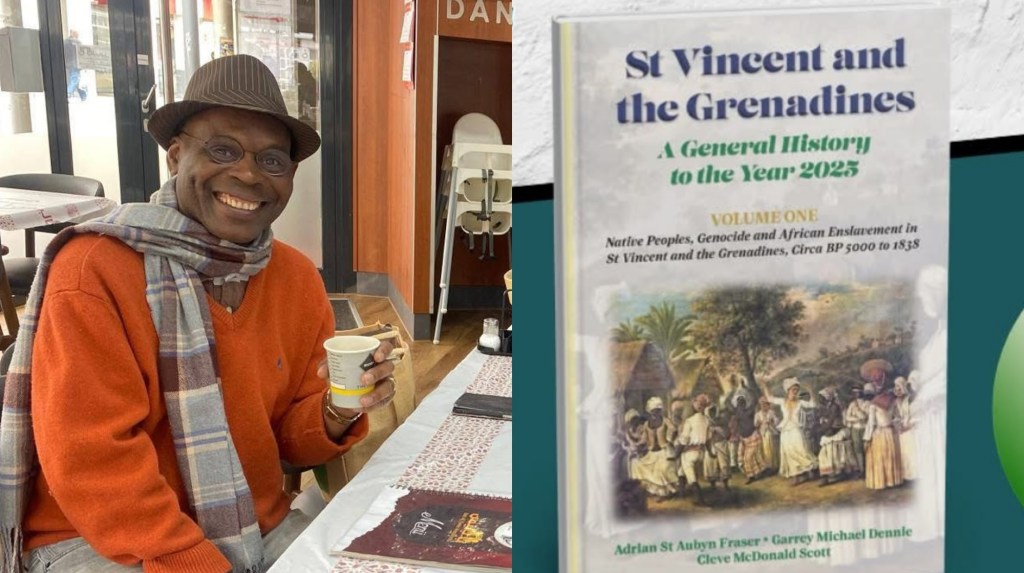
The following piece entitled: Knowing and embracing ourselves: A history of purpose by Drs. Dennie, Fraser and Scott is a book review written by Professor Dr. Richard Byron-Cox.
By Dr. Richard A. Byron-Cox.
The average person has the desire to know his/her familial origin. Who were his/her great grandparents, grandparents and the like. In the case of adoption, even if by excellent foster parents, they usually still want to know their biological forebears. For, “From whence we came?” is a question we all want answered. Strangely, this does not seem to hold much when we speak of our nation, but in the same way we generally draw strength, inspiration, and pride from the history of our familial lineage, so too, the history of our nation can inspire us to aspire. This latter fact underlines the invaluable significance of “St Vincent and the Grenadines: A General History to the Year 2025” written by Vincentian historians Doctors Fraser, Dennie, and Scott.
Recently released, the first volume of the work focuses on native genocide and the enslavement of African bodies. This is to be followed by two more in due course. This first volume containing over three hundred pages, divided into five chapters, covering the period from around BP 5000 to 1838, is a precious gift to our people in many fundamental ways. Firstly, it shows that this land’s history began long before the European colonizers arrived, who through inhumanity and unspeakable brutality stole this land from the First Peoples, establishing an illegal British reign, born out of genocide and which matured into slavery. The writers show how this fact changed forever the historical trajectory of the land we now call St. Vincent and the Grenadines. Their detailing this horror offers inter alia, an unshakable foundation for SVG’s and CARICOM’s just demands for reparations from Europe for native genocide and the enslavement of Africans bodies.
Secondly, and of truly vast importance, this work goes a very long way in furthering the process of decolonising our history and our understanding of that history, which in and of itself is probably the most significant part in the decolonisation of our education, which needless to say, is a mammoth, but unavoidable task! In this regard Fraser, Dennie, and Scott declare, “Our work offers new interpretations. Access to new evidence has allowed for some reconstruction…..” The further state that “…the objective is to offer a more accurate representation of the past.” These affirmations make it abundantly clear that from the get go, our authors are determined to let historical facts speak, and do not intend to give us a vanished account leading to a second lopsided misinterpretation of our past.
Thirdly, this work is not focused on statistical history, where churning out mere numbers is the primary objective. Nor is it one written through the eyes of some Anglophile historian, penning praises of the British empire, and colouring the truth in an effort to misrepresent their role in the historical criminal exercise of settler-colonialism to which SVG was subjected. Rather, it brings to the forefront “the lived experiences of the Vincentian peoples.” Or to paraphrase historian Howard Zinn, it is a peoples’ history of St. Vincent and the Grenadines. Indeed, the authors boldly claim that the methodology applied is one of “recording history from below, a perspective that focuses on lives of ordinary people.” This approach is another crucial element making this work our history. That is, it is written by us (all three authors are Vincentians); it is about us, the peoples of SVG; as distinct from notes simply recording when the colonists came, and in untrue light, what they did. But most crucially, it shows that we were and are the makers of this history! As writers says, the key is “to recognise Vincentians as subjects in their own history.”
Fourthly, this work shows with evidence that “Every square inch of St Vincent and the Grenadines was a crime scene of genocide, robbery, murder, rape, disenfranchisement, and exploitation; all crimes created by the colonising power during the colonial period.” And all of this was committed against the natives (First Peoples) and the enslaved, who refused to be merely objects acted upon by these colonizing slave owners. No! They actively and creatively resisted the evils of imperialism, colonialism, slavery, and unbridled violence practised against them. Both native and enslavedrejected the monopoly of land, power, and freedom enforced by European interlopers. The many battles our forebears fought against these usurpers are recorded in chapters two and three of this work, paying tribute to their sacrifices and noting that they never gave up this struggle. Indeed, as regards the First Peoples, the work informs, “They were fiercely committed to the trans-generational struggle legitimised by the sacrifices of their forebears, whether through moral support or fiercely engaging in battle.” Concerning the enslaved the authors underlined, “The resolve demonstrated by the enslaved was remarkable. In St Vincent and the Grenadines, as elsewhere in the Caribbean, they never conceded defeat and continued to show that, if the end of chattel slavery did not come from above, it would come from below.”
Fifthly, this is history with a noble purpose. It is crystal clear that the authors intend that it be a tool to help in the advancement of a people. Consequently, this first volume is not a record of stylised facts, neither is it a mere academic offering bereft of any real meaning to a 21st century SVG. It is an historical resource that testifies to the truth of our realisation of our creed over time, “What e’er the future brings, Our faith will see us through.”
Finally, this work shows the place and role of SVG in the history of the Caribbean, or what is alternately call the West Indies. At school when I read books like “The Making of the West Indies;” and “Pre-emancipation”, precious little was said of St. Vincent and the Grenadines. It was as if we were an unimportant, accidental, minor-decorative article in a story about others. This work has changed that forever underlining,“The peoples of St Vincent and the Grenadines have played a significant role in the construction of a broader Caribbean-wide identity.”
It would be remiss of me not to mention that the work is written in a style and using language very accessible to the public at large. Here too the authors understood that this is the people’s history that therefore must of necessity be comprehensible to all the people. It is part of your story as a Vincentian, and you need to read it.
There will be an official launch of this remarkable work on Friday 20th March at the UWI Open Camus to which the public is invited. May I impress upon you to please attend this profoundly historical event, and actively join the rest of ournation in accepting this special gift from Doctors Dennie, Fraser, and Scott.
END
 One News SVG